Thursday, 14 November 2013

Galaxies and Star Clusters

Hello everyone!
Continuing the theme of stars, in this post we will talk about Galaxies and Star Clusters. So what is the difference between Galaxies and Star Clusters? Don't they both contain a lot of stars? 


Galaxies are huge clusters of stars, dust and gas. They usually contain several million to over a trillion stars and can range in size from a few thousand to several hundred thousand light-years across. There are hundreds of billions of galaxies in the Universe. Galaxies come in many different sizes, shapes and brightness’s and, like stars, are found alone, in pairs in in larger groups called clusters. Galaxies are divided into three basic types: spirals, ellipticals and irregulars. Figure 1 shows the different types of galaxies and their classifications.


Figure 1


Star clusters are either one of two general types of stellar assemblages held together by the mutual gravitational attraction of its members, which are physically related through common origin. The two types are open (formerly called galactic) clusters and globular clusters. Open clusters contain from a dozen to many hundreds of stars, usually in an unsymmetrical arrangement. By contrast, globular clusters are old systems containing thousands to hundreds of thousands of stars closely packed in a symmetrical, roughly spherical form. In addition, groups called associations, made up of a few dozen to hundreds of stars of similar type and common origin whose density in space is less than that of the surrounding field, are also recognised.

One of the most famous star clusters is Pleiades. In Greek mythology, the Pleiades were seven sisters: Maia, Electra, Alcyone, Taygete, Asterope, Celaeno and Merope. Their parents were Atlas, a Titan who held up the sky, and the oceanid Pleione, the protectress of sailing. After a chance meeting with hunter Orion, the Pleiades and their mother because the object of his pursuit. Enamoured with the young women he pursued them over the face of the Earth. In pity for their plight, Zeus changed them into a flock of doves, which he set in the heavens. Thus the Olympian added the penalty of the absence of his wife and family to the Titan’s original punishment of eternally supporting the heavens from the Earth.

 
Figure 2: The Pleiades


Only six stars are distinctly visible to the naked eye (figure 2). The ancient Greeks explained the sudden disappearance of the seventh star in various narratives. According to one, all the Pleiades were consorts to the gods, with the exception of Merope. She deserted her sisters in shame, having taken a mortal husband, Sisyphus, the King of Corinth. Another explanation for the “lost” star related to the myth of Electra, an ancestress of the royal house of Troy. After the destruction of Troy, the grief stricken Electra abandoned her sisters and was transformed into a comet – to be a sign of impending doom.

The Greek legends of the disappearing star are echoed in Jewish, Hindu and Mongolian folklore: their basis is an actual event seems to be corroborated by astronomical evidence that a clearly visible star in the cluster becomes extinct towards the end of the second millennium BC.


The Milky Way is spinning and is also moving through the universe. Despite how empty space may seem in the movies, it is filled with dust and gas – and other galaxies. The massive collections of stars are constantly crashing into one another, and the Milky Way is not immune. In about four billion years, the Milky Way will collide with its nearest neighbour, the Andromeda Galaxy. The two are rushing towards each other at about 112km per second. When they collide they will provide a fresh influx of material that will kick start star formation.

Figure 3: Andromeda Galaxy

The Andromeda Galaxy (figure 3) is obviously not the most careful drivers. It show signs of having already crashed into another galaxy in the past. Although it is the same age as the Milky Way, it hosts a larger ring of dust in its centre, and several older stars. Of course, the imminent collision shouldn’t be a problem for inhabitants of Earth. By the time the two galaxies ram headlong, the sun will already have ballooned into a red giant, making our planet uninhabitable.

This prac will help with the understanding of how galaxies swirl for all ages. You need a round glass or aluminium pie-pan, a coin and a sprinkle of dots from paper punch.

  1. Place the coin under the centre of the pie-pan on a kitchen counter, so the pan turns easily.
  2. Pour about 2 cm of tap water into the pan.
  3. Carefully sprinkle the paper-punch dots in the centre of the pan so that they float.
  4. Spin the pan slowly. Notice how the dots stream into spiral arms.


The local group is the name Edwin Hubble gave to the galaxies nearest to the Milky Way. Today, astronomers know of about 35 Local Group galaxies spread across roughly 8 million light-years of space. This is not a random collection of galaxies that just happen to lie nearby. Linked by the pull of gravity, the Local Group members form a cluster of galaxies, just as the Pleiades forms a cluster of stars.


Two big galaxies dominate the Local Group - The Milky Way and the Andromeda Galaxy, which is slightly larger. Each has attracted a collection of smaller Local Group galaxies. Belonging to the Andromeda Galaxy are M32, NCG 147, MGC 185, NCG 205 and four dwarf galaxies. The Pinwheel (M33), the third-largest galaxy in the group, also lies near Andromeda. The Milky Way's satellite groups are the Large and Small Magellanic Clouds and several dwarf galaxies. The rest of the Local Group galaxies appear to stand alone.

Answers to previous questions:
  1. 3, 440, 337, 033
  2. 12, 865, 416, 906
  3. 7, 031, 099, 937
  4. 13, 763, 004, 132
  5. 1, 795, 174, 452
  6. Voyager 1
  7. A planet with 11 times Jupiter's mass that orbits the star HD 75289
  8. Study small pulsations in stars and search for planets.
  9. A planet with 0.4 times Jupiter's mass that orbits the star HD 114762

Research Questions:
  1. What are some famous elliptical galaxies
  2. Name 3 more Star cluster and whether they are globular or open.
  3. Find 5 things that the Andromeda Galaxy Milky Way have in common.
  4. What are the names of 5 of the dwarf galaxies (and what type are they) in our Local Group?

Q: How do you organise a space party?
A: You planet!

Enjoy :)

Emily.

Tuesday, 12 November 2013

Other Solar systems

Hello Everyone!

In my last post, I talked about what stars were. In this post I will talk about other solar systems and what is involved with what's out there.


The first thing that we will talk about is how other solar systems are located. The most common method is Doppler spectroscopy, a technique that has located around 90 % of exoplanets. It uses radial velocity measurements through examining Doppler shifts in the spectrum of a star around which the planet orbits. Astronomers look for tiny changes in a star’s radial velocity. For example, Jupiter causes the sun to change velocity by about 13 metres per second over a period of 12 years. By tracking these changes over time, astronomers can estimate a planet’s minimum mass.

Another way to identify an exoplanet is to watch the brightness of a parent star. If it dims for a short time, it could indicate a transit – a planet crossing in front of the star. This has been the second most useful method of discovery, but it does lead to a number of false positives. In addition, some astronomers use astrometry – pinpointing the position of a star in the sky and seeing how it makes tiny changes in its positing, which could indicate a planet nearby. This is called star wobbling.
The next point that we will talk about is what an AU actually is. In astronomy, you may have heard it here or there, something is so many AU away, etc. AU is actually short for Astronomical Unit. It is 149,597,871km or the distance from the Earth to the Sun.
Convert the following AU to km.
  1. 23
  2. 86
  3. 47
  4. 92
  5. 12
Figure 1: An example of other solar systems and comparing them to our own.

The third and final point that we will be talking about today is deep space probes. Do you remember names like Pioneer, Explorer, Mariner, Venera, Luna, Ranger, Voyager, Zond, or Surveyor? Many of the early probes launched by the United States and the former Soviet Union have borne these names. Soon after the Soviet Union launched the first artificial satellite, Sputnik 1 on 4 October 1957, both the former Soviet Union and the United States began to launch a flurry of probes to the Moon, Mars and Venus.

So, just what is a space probe, anyway? A space probe is an un-piloted spacecraft that is used to make observations and send information back to Earth regarding these observed objects. While many satellites are also space probes, we will be discovering those which have escaped earths gravity. These probes carry sophisticated equipment, such as infrared sensors, radars, ultraviolet sensors, magnetometers, soil analysers, spectrometers, and sensors to study wind velocities or chemical compositions. They are various cameras, navigation, and communications systems. There also has to be a power supply and protection against heat, cold, and cosmic radiation. Exactly what equipment is on any deep space probe, of course, depends upon its mission.

Answers to previous questions:
  1. Yes, close one eye and pick an object, now switch eyes. Has it moved? That is parallax.
  2. Alpha Centauri, Algol, Beta Lyrae

Research Questions:
  1. What is the most successful deep space probe so far?
  2. What is the largest planet found outside the solar system?
  3. What does the space telescope COROT do?
  4. What is the smallest planet found outside the solar system?

Q:What did the alien say to the garden?
A: Take me to your weeder!

Enjoy! :)

Emily.

Wednesday, 6 November 2013

Stars, What are they?

Hello Everyone!
Last post, we talked about the life cycle of stars, so this time we are going to talk about what stars actually are and all the 'gritty' details.

Stars are given two different types of magnitudes, absolute and apparent magnitude. Absolute magnitude is the actual brightness of the star while apparent brightness is what the star looks like from a distance (Earth).


Stars are classified by the Hertzsprung-Russell diagram. The Hertzsprung-Russell diagram (HR diagram), named after Ejnar Hertzsprung and Henry Russell, is a graph which astronomers use to help us understand stars. Across the bottom we plot the stars temperature and down the side we plot the stars’ absolute magnitude. By charting stars this way we begin to see at pattern. A star’s temperature and colour depends directly on how big the star is. The bigger a star is the hotter it will be. This is because the stronger gravity of larger stars causes them to burn their fuel more quickly raising the stars temperature. The stronger an objects gravity is, the more power it has to pull its mass inward. This causes the core to be very compact and creates a lot of extra pressure. This extra pressure builds up, raising the temperature of the core. The hotter the core gets, the more of its hydrogen fuel it will burn.


THIS LINK shows an interactive HR diagram.
Answer the following questions:

  1. At what age does the example star first enter the main sequence?
  2. At the stage of Red Giant, how large (according to the diagram) is the star
  3. What is the example given for the White Dwarf?
  4. What is the age used for stellar death (in the example)?

The next topic, eclipsing binary stars, is of particular personal interest to me. THIS LINK shows a binary star system simulator. (It's really fun and interesting to play with). 

Set the simulator to the following settings and record you observations about the light curve placed just above the settings. Why do you think this happens?

  1. Star 1 with a Mass of 85, radius of 17, and Temperature of 45000K.
  2. Star 2 with a Mass of 85, radius of 17 and temperature of 45000K
  3. Separation at 60.00
  4. Eccentricity at 0.44

The majority of starts are not single stars, they come in pairs of two or more stars (even in star clusters, containing thousands of stars – globular clusters), orbiting around a common gravitational centre and following Kepler’s Laws. Some stars are easy to detect, others require different measures for detection. On the night sky, some stars may appear to be a binary star system, but they are coincidentally placed close to each other.

At first, astronomers thought all stars simply appeared to be double stars, but in 1902 Sir William Herschel discovered that many of the stars that appeared close to each other actually had changed in position relative to each other. Binary stars that can be distinguished through an optical telescope are called visual binaries. An example of an optical binary is the Mizar in the northern hemisphere, which is the second star to the left in the handle of the constellation The Big Dipper, or more precisely: Usae Majoris, The Big Bear.

Figure 1: Mizar using Stellarium


 Mizar (figure 1) is actually a binary system which can be distinguished with the naked eye, and is a fine target for amateur astronomers who wish to test their eyesight. The second component of the star is called Alcor, or Mizar B (figure 2). 

Figure 2: Mizar and Alcor using Stellarium
Later studies have revealed that both stars are in turn binaries, which makes the entire Mizar complex a system of FOUR STARS! (figure 3) 

Figure 3: Mizar Binary using Stellarium
The discovery was made using spectroscopy, which is a method used to detect unseen companions. Binaries discovered with the method are called spectroscopic binaries. When detected, it is relatively easy to calculate the mass of the binary star system, which is more difficult for single stars. The closest star to our sun, located 4.6 light years away is Proxima Centauri, which is actually a system of three stars. Alpha Centauri is the brightest of the three.

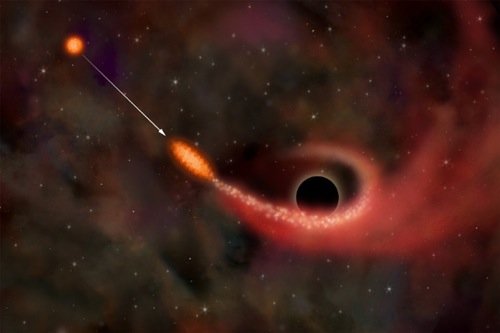
Figure 4: A star being pulled into a black hole.

Binary star systems can vary greatly and are very interesting to study. Each component can have an affect on the other partner’s course of life. Systems containing a white dwarf can display a nova, which is an energetic explosion, which can be seen at great distances. Other systems, may contain a neutron star, or even a black hole, which strips off gas from its companion star. The gas is accelerated towards the compact object and heated to more than 1,000,000°K, which is enough to produce X-Rays! (figure 4)

Variable stars are stars that change brightness. The brightness changes of these stars can range from a thousandth of a magnitude to as much as twenty magnitudes over periods of a fraction of a second to years, depending on the type of variable star. Over 150,000 variable stars are known and catalogued, and many thousands more are suspected to be variable.
There are a number of reasons why variable stars change their brightness. Pulsating variables, for example, swell and shrink due to internal forces. An eclipsing binary will dim when it is eclipsed by a faint companion, and then brighten when the occulting star moves out of the way. Some variable stars are actually extremely close pairs of stars, exchanging mass as one star strips the atmosphere from the other.

The different causes of light variation in variable stars provide the impetus for classifying the stars into different categories. Variable stars are classified as either intrinsic, wherein variability is caused by physical changes such as pulsation or eruption in the star or stellar system, or extrinsic, wherein variability is caused by the eclipse of one star by another, the transit of an extra solar planet, or by the effects of stellar rotation.


Figure 5: Parallax


Parallax is the optical illusion that two stationary points change in position relative to each other, due to a difference in position of the person viewing them. The two points in question will be different distances from the observer and the illusion of parallax is cause by the fact that light, follows straight lines (figure 5). When the observer views the nearer point, the line of his vision toward that point is at given angle within the full arc of his vision. For example, let us say that the view straight ahead is zero degrees, and one point, near the observer, is at minus five degrees while a point which is farther away is at minus two degrees. The apparent angular distance between the points is a subjective three degrees to the viewer. If the viewer moves ten metres to his right, the angular direction to the nearer object, as it is on a shorter radius, will change more than the angular direction to the farther object. So, for instance, when the angular direction to the nearer object is at minus ten degrees, the farther object may only have moved to minus three degrees. Now the subjective angular difference in position is seven degrees. The objects appear to have moved relative to each other.

Answers to previous research questions:
  1. No, they haven't been proven.
  2. Red, yellow, white, blue
  3. Nuclear fusion is when two or more lightweight atoms join together to from one heavier nucleus, with any energy released due to the conversion into nuclear energy.
  4. Orion Nebula
  5. Orion Nebula

Research Questions:
  1. Can/Do we use Parallax in our everyday lives?
  2. What are some other Binary star systems?
  3. Draw your own HR Diagram with the following stars, Bellatrix, Betelgeuse, Sirius, Altair, Maia, Navi and Vega
Q:Why didn't the dog star laugh at a joke?
A: Because it was too Sirius!


Cheers :)

Emily.